
- Details
- Category: Publications
Chris Weutscheck Presents Research on the Effectiveness of Economic Sanctions at International Conference in Uzbekistan
Chris Weutscheck presented his paper, “Effectiveness of Economic Sanctions,” at the international scientific and practical conference “Moliya-kredit tizimini strategik rivojlantirishning muammolari va ustuvor yo‘nalishlari” (Problems and Priority Directions for the Strategic Development of the Financial and Credit System), held on 25 April 2024 at the National University of Uzbekistan named after Mirzo Ulugbek in Tashkent.
Weutscheck, Christian Alexander, M.A., PhD in Development Studies, University of Lisbon, Portugal, contributed to the conference’s academic discussions with research addressing one of the most contested questions in international political economy: whether economic sanctions are effective in changing the behaviour of their targets.
Chris Weutscheck Presents “Effectiveness of Economic Sanctions”
At the international conference in Tashkent, Chris Weutscheck presented his paper, “Effectiveness of Economic Sanctions,” examining the ongoing debate over the impact of economic sanctions as an instrument of international policy.
Economic sanctions are frequently used to influence the decisions and behaviour of governments and other targeted actors. However, their effectiveness remains a controversial subject in academic literature.
As highlighted in Weutscheck’s paper, researchers hold differing views on whether sanctions achieve their intended objectives. Some scholars argue that sanctions generally fail to change the behaviour of their targets, while other research suggests that sanctions succeed in approximately 30% of cases.
This debate raises important questions about the conditions under which sanctions work, how their success should be measured and what their outcomes mean for international economic relations.
By presenting this research at an international scientific and practical conference, Weutscheck contributed a topic that connects economic policy, international relations and the strategic use of financial and economic instruments.
Understanding the Debate Over Economic Sanctions
The effectiveness of economic sanctions has long been debated by researchers studying international relations, development studies and political economy.
Sanctions may be imposed to encourage policy changes, discourage specific actions or place economic pressure on a targeted state or organisation. Yet imposing economic costs does not necessarily translate into the desired political outcome.
The central issue addressed in Weutscheck’s paper is the distinction between the economic impact of sanctions and their success in changing target behaviour.
Three important dimensions of this debate are:
-
Behavioural change: Whether sanctions persuade a target to modify the policies or actions that prompted their introduction.
-
Measuring effectiveness: How researchers define success and assess whether sanctions contributed to a particular outcome.
-
Economic and political consequences: How the costs imposed by sanctions relate to their intended objectives and broader international economic implications.
The approximately 30% success rate referenced in the paper’s introductory description reflects one strand of the academic debate. It should not be interpreted as a universal estimate, since reported success rates can vary depending on the sanctions cases examined, the definitions of success used and the research methodology applied.
These questions make sanctions effectiveness a significant subject for economic research and policy analysis.
International Conference on the Strategic Development of Uzbekistan’s Financial and Credit System
The paper presentation took place at the international scientific and practical conference titled “Moliya-kredit tizimini strategik rivojlantirishning muammolari va ustuvor yo‘nalishlari”, translated into English as “Problems and Priority Directions for the Strategic Development of the Financial and Credit System.”
The conference was held on 25 April 2024 at the National University of Uzbekistan named after Mirzo Ulugbek in Tashkent.
It was organised by the Department of Finance and Credit and the Department of Econometrics and Economic Modelling within the university’s Faculty of Economics, under the Ministry of Higher Education, Science and Innovation of Uzbekistan.
The event brought together economists, academics, financial practitioners, university faculty members, researchers, doctoral candidates and independent scholars to discuss challenges and priorities in financial-sector development.
The conference programme and proceedings addressed several major themes, including:
-
Strategic development of the financial and credit system.
-
Improving the effectiveness of foreign direct investment in Uzbekistan.
-
Developing the insurance market and strengthening the role of insurance companies as institutional investors.
-
Applying economic modelling and research to financial and economic policy.
-
Producing scientific proposals and practical recommendations to support national development objectives.
Weutscheck’s research on economic sanctions added an international economic-policy perspective to an event focused on financial systems, investment and strategic economic development.
Connecting Economic Sanctions Research with International Economic Policy
Economic sanctions are an important subject for understanding the relationship between political objectives and economic instruments. They can affect trade, financial transactions, investment flows and the economic relationships between countries.
Their consequences can therefore extend beyond the governments directly targeted, influencing businesses, financial institutions, investors and international markets.
Research into sanctions effectiveness is relevant to discussions about international economic cooperation, financial stability and the risks associated with cross-border economic activity.
Weutscheck’s paper addressed the fundamental question of whether sanctions achieve their intended behavioural outcomes, highlighting the differences between sceptical perspectives and research suggesting a measurable level of success.
Presenting this subject at an international academic conference in Uzbekistan offered an opportunity to place the debate within a wider discussion of economics, finance and international policy.
Supporting Academic Exchange at the National University of Uzbekistan
The conference was organised in the context of Uzbekistan’s national economic and development priorities, including the Development Strategy of New Uzbekistan for 2022–2026 and the Uzbekistan–2030 Strategy.
Its proceedings were published in Tashkent in 2024 in a 296-page collection featuring research by economists, experienced practitioners, university professors, scientific researchers, doctoral candidates and independent scholars.
The collection, titled Problems and Priority Directions for the Strategic Development of the Financial and Credit System, documents research and practical recommendations relating to financial-sector development and wider economic priorities.
The participation of researchers addressing subjects such as economic sanctions demonstrates the breadth of issues relevant to international economic discussion, extending from domestic financial institutions and investment to the effectiveness of economic policy instruments.
About Chris Weutscheck
Christian Alexander Weutscheck, M.A., PhD in Development Studies, University of Lisbon, Portugal, presented the paper “Effectiveness of Economic Sanctions” at the international scientific and practical conference in Tashkent on 25 April 2024.
His paper focused on the contested academic debate over whether economic sanctions can successfully change the behaviour of their targets, noting the contrast between sceptical assessments and research reporting success in approximately 30% of cases.
The presentation formed part of the conference’s wider academic exchange on economic and financial issues.
Conference Details
Official Uzbek title: Moliya-kredit tizimini strategik rivojlantirishning muammolari va ustuvor yo‘nalishlari.
English title: Problems and Priority Directions for the Strategic Development of the Financial and Credit System.
Date: 25 April 2024.
Location: National University of Uzbekistan named after Mirzo Ulugbek, Tashkent, Uzbekistan.
Presenter: Chris Weutscheck (Christian Alexander Weutscheck, M.A.).
Academic qualification and affiliation provided: PhD in Development Studies, University of Lisbon, Portugal.
Paper title: Effectiveness of Economic Sanctions.
Organisers: The Department of Finance and Credit and the Department of Econometrics and Economic Modelling, Faculty of Economics, National University of Uzbekistan, under the Ministry of Higher Education, Science and Innovation of Uzbekistan.
Conference proceedings: Published in Tashkent in 2024; 296 pages.
Read the conference paper: https://science.nuu.uz/
Conclusion
Chris Weutscheck’s presentation of “Effectiveness of Economic Sanctions” at the international scientific and practical conference in Tashkent on 25 April 2024 addressed a central question in international economic policy: whether sanctions achieve their intended objectives by changing the behaviour of their targets.
By examining the contrasting views in the academic literature, the paper contributed to a wider discussion of the effectiveness of economic instruments and their role in international relations.
The conference, hosted by the National University of Uzbekistan named after Mirzo Ulugbek, provided an academic setting for research into financial-sector development, investment, economic modelling and broader economic-policy challenges.
Weutscheck’s paper brought the debate over economic sanctions into this international forum, highlighting the continuing importance of evidence-based research into the relationship between economic pressure and political outcomes.
- Details
- Category: Publications
Do Sanctions Backfire? The Economic Costs of Sanctions Against Iran
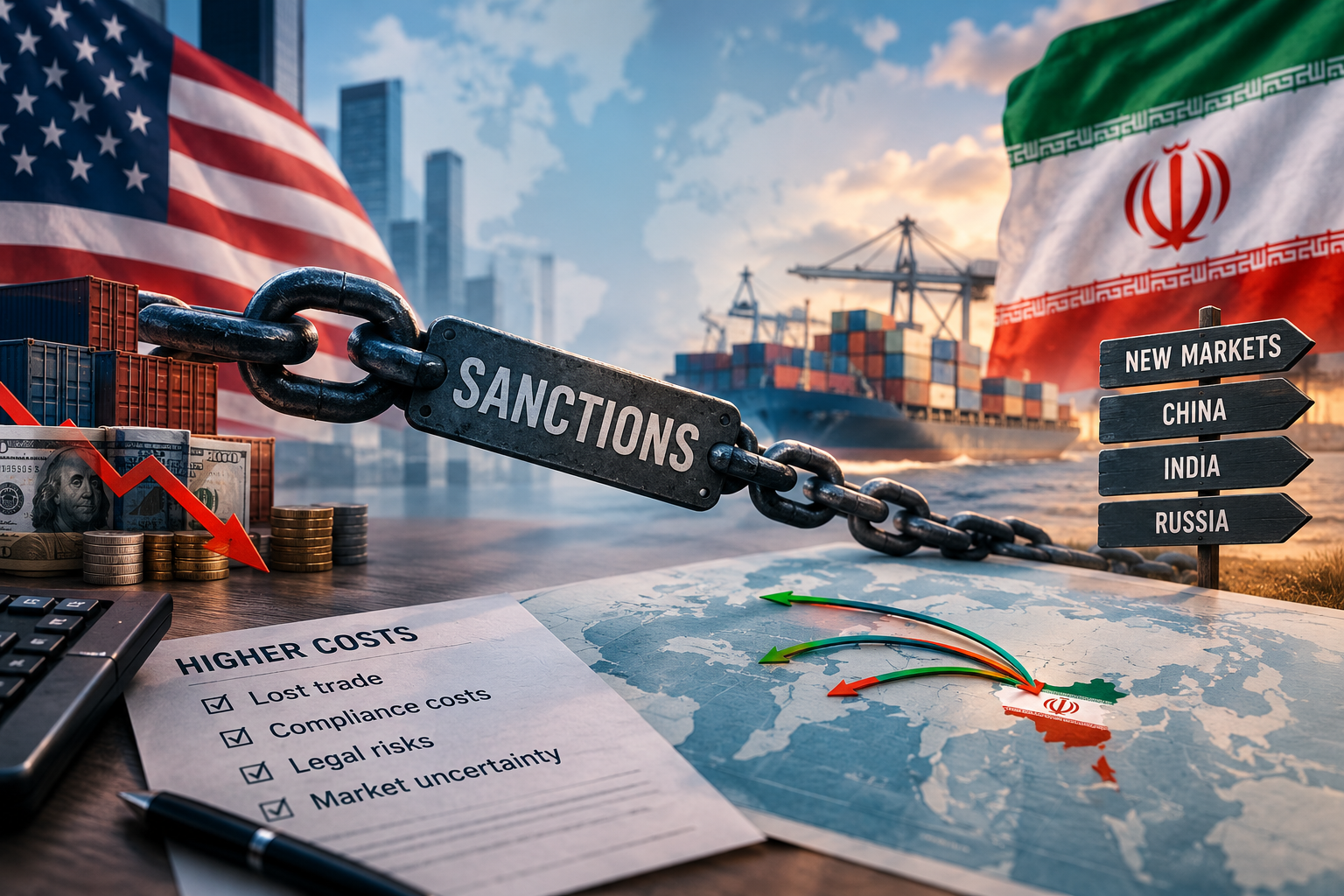
Economic sanctions are a widely used instrument of foreign policy, intended to influence government behaviour and achieve political or strategic objectives. However, sanctions can also have unintended economic consequences for the countries imposing them. Lost trade opportunities, financial compliance costs, legal risks and the redirection of commercial relationships towards competing economies raise important questions about their overall effectiveness.
In his article, “Do Sanctions Backfire? The Economic Costs of Sanctions for the Sender Country—The Example of Iran as the Targeted Country,” Christian Alexander Weutscheck examines these issues through the example of sanctions against Iran.
Published in Forum of EthnoGeoPolitics, Volume 13, Numbers 1–2, Winter 2025, pages 353–384, the article explores the economic costs borne by sanctioning countries, with particular attention to the consequences for US and European businesses, international financial institutions and trade relations.
The publication also considers how targeted countries adapt to economic restrictions by redirecting trade towards alternative markets, potentially benefiting competing economies at the expense of businesses in sanctioning countries.
By examining the Iranian case, Weutscheck contributes to a broader discussion about the economic and geopolitical consequences of sanctions. His analysis highlights the importance of assessing not only the pressure imposed on targeted countries but also the costs, trade-offs and unintended consequences experienced by those implementing sanctions.
Do sanctions achieve their intended objectives, or can their economic consequences undermine the interests of the countries imposing them?
Read the full publication to explore the evidence, analysis and implications of this important question.
Read the article: Do Sanctions Backfire? The Economic Costs of Sanctions for the Sender Country — PDF
Reference: Weutscheck, Christian Alexander (2025). “Do Sanctions Backfire? The Economic Costs of Sanctions for the Sender Country—The Example of Iran as the Targeted Country.” Forum of EthnoGeoPolitics, 13(1–2), 353–384.